
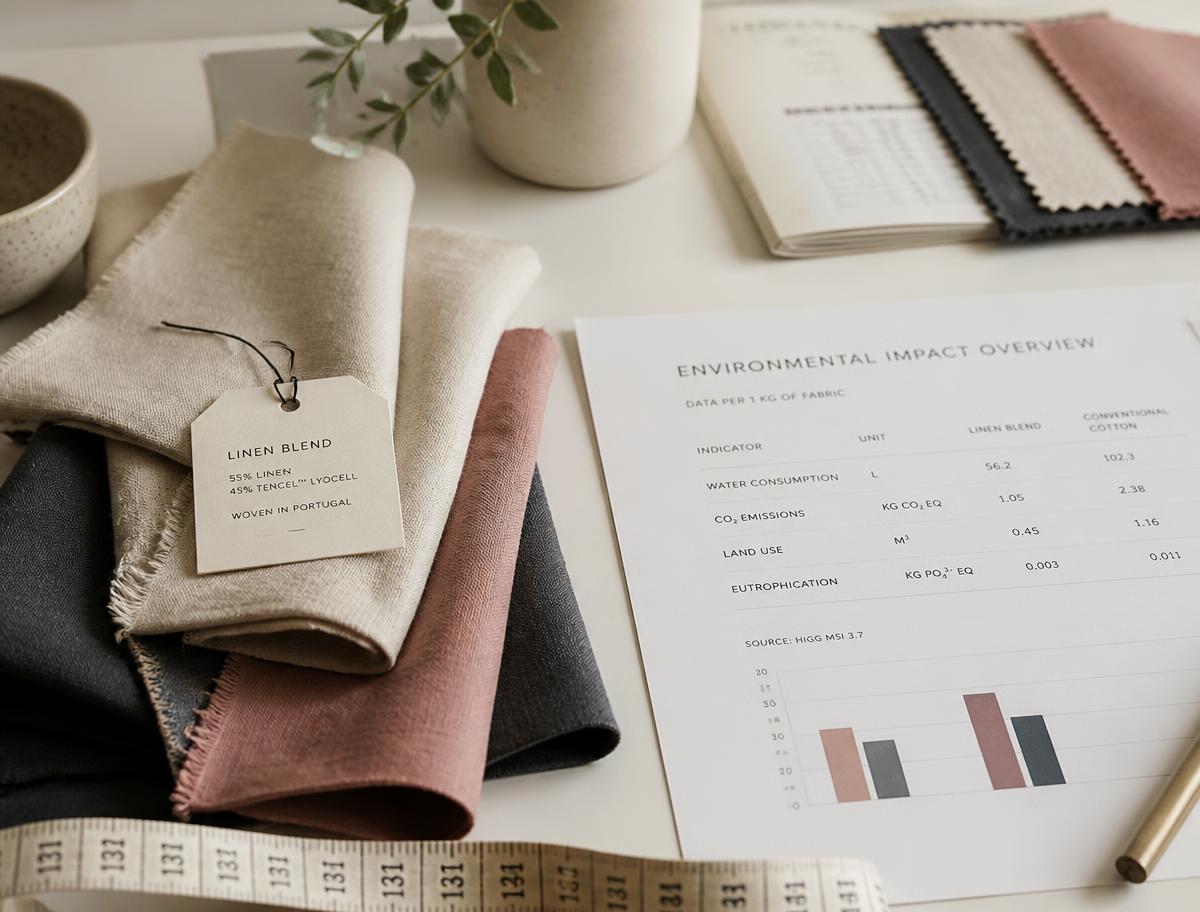
Textile LCA and regulation: measuring fashion's impact with OffCarbon
For a long time, talking about impact in fashion was a matter of intent. Today it is a matter of calculation. Between environmental labelling, France's AGEC law and the European sustainability reporting directive, brands have to quantify what they produce — and prove what they claim. At Azala, this shift matters to us: upcycling is only worth something if it can be measured.
What is a textile LCA?
A life cycle assessment (LCA) is a standardised method that quantifies the environmental impacts of a product across its entire existence. For a garment, that means tracing the whole chain:
- Raw material — cotton farming, synthetic fibre production, wool farming.
- Spinning and weaving — turning fibre into fabric, an energy-intensive stage.
- Finishing — dyeing, printing, treatments: often the heaviest stage for water and chemicals.
- Making — assembly, finishing, quality control.
- Transport and distribution — modes, distances, packaging.
- Use — washing, drying and ironing over the garment's real lifespan.
- End of life — reuse, recycling, incineration or landfill.
The result is not a single carbon figure. A serious LCA documents several indicators: greenhouse gas emissions, water consumption, aquatic ecotoxicity, eutrophication, land use. That is exactly what makes the exercise useful: a garment can be low in carbon and disastrous in toxicity, or the other way round.
In France, the reference methodology is Ecobalyse, developed by public authorities to harmonise how the environmental cost of clothing is calculated. It includes parameters long absent from classic LCAs: physical durability, number of references placed on the market, incentives to repair. The consultancy OffCarbon works with this methodology daily for fashion, leather goods and beauty brands.
The regulatory framework
Three sets of rules shape the subject today, each with its own logic.
The AGEC law
Since 2022 it has imposed consumer information duties: presence of plastic microfibres, geographic traceability of manufacturing stages, recycled content, hazardous substances. It also bans the destruction of unsold non-food goods — a point that considerably increased brand interest in reuse and upcycling.
Environmental labelling
The principle: display an impact score the consumer can read, calculated with a shared method. Voluntary at first, it becomes a de facto standard as soon as the first brands adopt it — consumers compare, and the absence of a score becomes a signal in itself. This sits at the heart of OffCarbon's LCA and compliance work.
CSRD, ESRS and the Green Claims directive
The CSRD widens the scope of non-financial reporting: companies in scope must publish audited environmental and social data following the ESRS standards. In parallel, the European directive on environmental claims governs the discourse: any claim such as "eco-friendly", "carbon neutral" or "sustainable" must rest on verifiable evidence. Measurement is no longer only a management tool — it is the precondition for speaking at all.
From measurement to action
A well-run LCA is first and foremost a decision tool. In the vast majority of cases it shows that most of the impact happens upstream: material choice and finishing stages usually weigh more than everything else combined. That immediately reorders priorities.
- Sourcing — substituting a high-impact material, bringing production closer, questioning dyeing processes.
- Eco-design — simplifying assembly, reducing offcuts, designing for repair.
- Durability — a garment worn twice as long halves its impact per wear: the most powerful and least costly lever.
- Material reuse — bringing dormant stock and production offcuts into collections.
All of this requires the ability to industrialise the calculation. Running an LCA on one style is a project; running it across a full collection, season after season, requires tooling. That is the logic behind the offcarbon.io platform, which automates the calculation and gives product teams a materials database and reporting they can actually use day to day.
What upcycling changes in the calculation
This is where it concerns us directly. At Azala we work from fabric offcuts left over from existing production runs. In LCA terms, that material arrives with a history already spent: fibre growing, spinning, weaving and dyeing happened independently of us, for someone else's order. Our production therefore avoids the heaviest stages of the chain.
That excuses nothing in terms of rigour. The allocation rule chosen — how upstream impact is split between the original product and the upcycled one — entirely determines the score displayed, and two defensible methods can produce very different figures. Sorting, transporting the offcuts, making and finishing remain fully on our side of the calculation.
Our position is simple: upcycling is a serious lever, provided it is documented with the same methodological demands as everything else. An advantage claimed without calculation is still greenwashing, even when it happens to be real.
Getting support
OffCarbon is a CSR consultancy dedicated to fashion, retail, leather goods and beauty brands. Over 100 brands supported, more than 1,000 LCAs completed and a proprietary database: the approach combines sector expertise, tooling and hands-on support rather than abstract reporting.
In practice that covers diagnosis and regulatory compliance, sourcing and supply chain optimisation, and building a brand narrative backed by evidence — the range of engagements is detailed here. Their journal documents several brand cases, including small structures.
Measure first, communicate second
Regulation is only accelerating a movement already under way: in a sector saturated with promises, data is the only credible argument left. For a brand, an LCA is not one more administrative burden — it is the moment you find out where your impact really sits, and often where your industrial improvement margins sit too.
Working on a collection and wondering how to bring in documented upcycled material? Let's talk.