
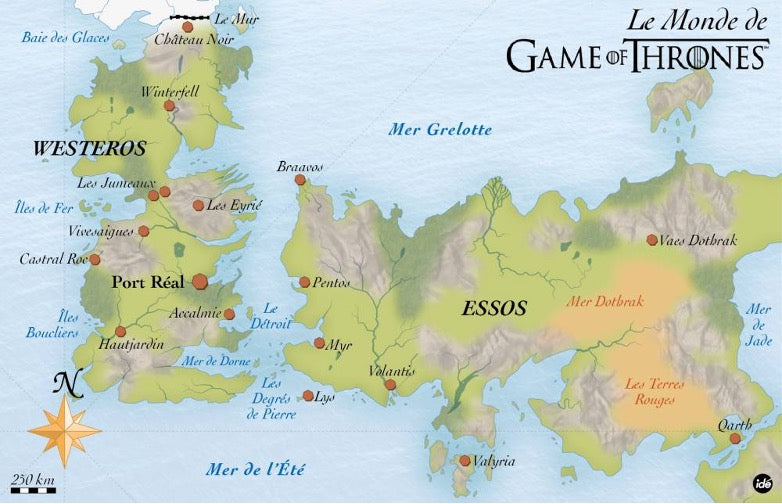
Game of Clothes: Your Garments Are Made Everywhere
Disclaimer 1: This story is a work of fiction! Any specific analogy to real life is purely coincidental...
Disclaimer 2: This article is not just for Game of Thrones fans!
A garment's origin is of crucial importance when one chooses to take an interest in social, ecological, or economic questions. To get this information, we refer to the famous made in... label, which generally indicates the place of a garment's final transformation; the exclusive or partial place of manufacture.
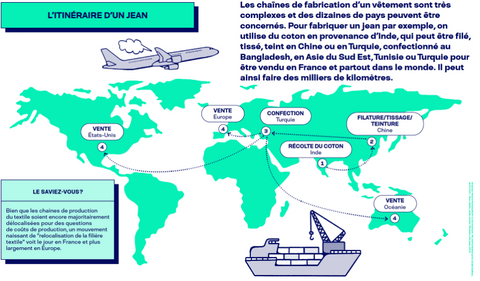
While for some consumer products, the information indicating the final origin is "sufficient," the textile supply chain is often too complex to be limited to this single piece of data. Between the place where the raw material is harvested or manufactured, the spinning location (transforming fiber into thread), the weaving location (fabric production), the manufacturing location (garment production), and the point of sale, several countries and continents are often involved in the supply chain of a single piece of clothing. According to Oxfam, it is estimated that a pair of jeans can travel up to 65,000 km to the final consumer, which is 1.5 times around the world.
Using the fantasy universe of George R.R. Martin, we will rewrite the story of a cotton tunic made in King's Landing...
In the year 297, Jamie Lannister strolls through the streets of King's Landing to find a new tunic that he will proudly wear at court. After an hour's walk through the winding streets of the city of kings, he comes across a newly opened shop: "Tunics Made in King's Landing." Jamie is thrilled; he is sick and tired of buying items made in Qarth... and being a knight of great conscience, he finds it a shame that so many slaves are exploited to manufacture and transport the tunics to King's Landing. Jamie is a Lannister, so he buys 150 tunics for his personal use, paying in cash, of course!
The Made in King's Landing Tunics
At the Queen's request, a royal investigator is sent on a mission to report on the merits of this new shop. To do so, he decides to speak with the region's successful new start-up founder:
Royal Investigator: Queen Cersei will be delighted to learn that we are producing on our soil again! Can you tell us more about the origin of your tunics?
Gendry (the tunic maker): Of course! Our tunics are made in our workshop located south of King's Landing, on the road to Storm's End.
Without a second thought, the investigator sets off for the tunic factory.
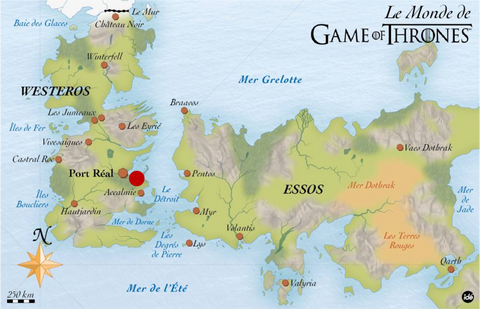
The investigator discovers a very fine workshop where more than 70 garment workers are singing as they work. He asks to speak with the workshop manager:
Royal Investigator: How many tunics do you make each day?
Robert (the workshop manager): We produce 10 tunics a day, which is more than 3,000 tunics a year. We manage to supply 13% of the demand in King's Landing (2019 INSEE study), which is almost the entire wardrobe of Ser Jamie Lannister.
Royal Investigator: Why not produce more?
Robert: Unfortunately, our tunics are more expensive than those produced in Essos, and not all inhabitants can afford one. Besides, if we encroach too much on Essos's exports, they might stop selling us fabric...
Royal Investigator: So make your own fabric!
Robert: We would need to do a market study... For now, we import 100% of our fabrics from Volantis (a port city on the continent of Essos).
The royal investigator understands that to satisfy the queen, he will have to travel a bit.
Volantis: The Fabric Mill for King's Landing
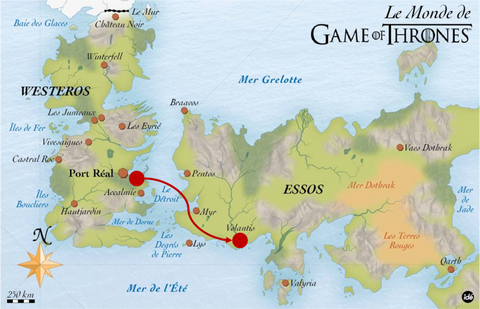
Royal Investigator: A fine business you have here!
Xerox (head of weaving): You can say that again! We are the largest fabric exporter on the continent, and we continue to grow year after year.
Royal Investigator: How do you explain this great success?
Xerox: Volantis has a direct connection with Qarth (a city of slavers located on the eastern part of the continent of Essos), they sell us the cheapest thread on the continent!
The royal investigator mutters under his breath, "another three weeks on horseback to reach Qarth, this is starting to get old."
Qarth: The City of Cotton Thread
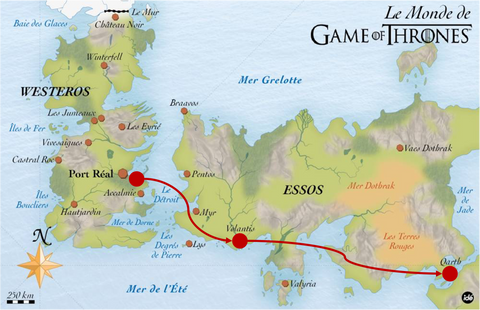
After a three-week journey, the investigator is a little on edge... He tries to get through this next meeting quickly.
Royal Investigator: Right! Why does all of Volantis get its thread from you?
(Someone who works at the spinning mill): My dear sir, for the simple reason that we have the cheapest cotton on the continent.
Royal Investigator: I don't understand...
(The same person): 51% of the WORLD'S cotton cultivation was held by the Dothraki in Vaes Dothrak (a town located in the North-East of the continent of Essos). We decimated the Dothraki and took over all the cotton fields!
This time, there's no need to go to Vaes Dothrak to understand. Besides, the royal investigator has no desire to continue his adventure, to be honest with you. He turns back to deliver his message to the queen.
Royal Investigator: My queen, I have returned from a great expedition that took me as far as Vaes Dothrak in the North-East of Essos. My conclusion is as follows: without re-industrializing Westeros by investing in weaving and spinning mills and in farms, we will never be able to truly produce locally!
Queen Cersei did not bother to answer the investigator; she had him executed to save her voice...
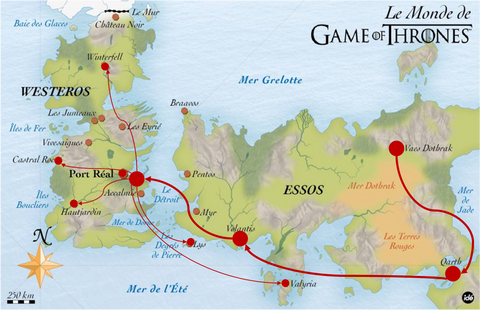
Appendix: Discover the Journey of the Made in King’s Landing Tunics
Moral of the story
The final transportation of a garment (from the place of manufacture to the point of sale) accounts for a small proportion of the textile industry's ecological footprint. However, current supply chains often send our wardrobe around the world several times... That is why it is urgent to re-centralize production sites and drastically reduce the back-and-forth trips upstream in the value chain!
Sources:
INSEE 2019: "Made in France": 81% of total household consumption, but only 36% of that for manufactured goods
Quote 1: "This share [of imported goods] is even 87% for textile consumption"
Quote 2: "36% of textile imports come from China"
Pietra Rivoli: The Travels of a T-Shirt in the Global Economy
Quote 1: "A T-shirt travels an average of 40,000 km before you can wear it"
Quote 2: "‘Made in France’ is not always a guarantee of a reduced carbon footprint"
Quote 3: "Indeed, while it may be a French-made article, the raw materials may have been grown, woven, and collected elsewhere than in France"
Chaussettes Orphelines
Quote: "According to her calculations [Pietra Rivoli's] and those of ADEME, transport represents between 3 and 5% of a garment's impact"
ADEME 2022: The Other Side of My Look
Sofiane Bouhali for Azala