
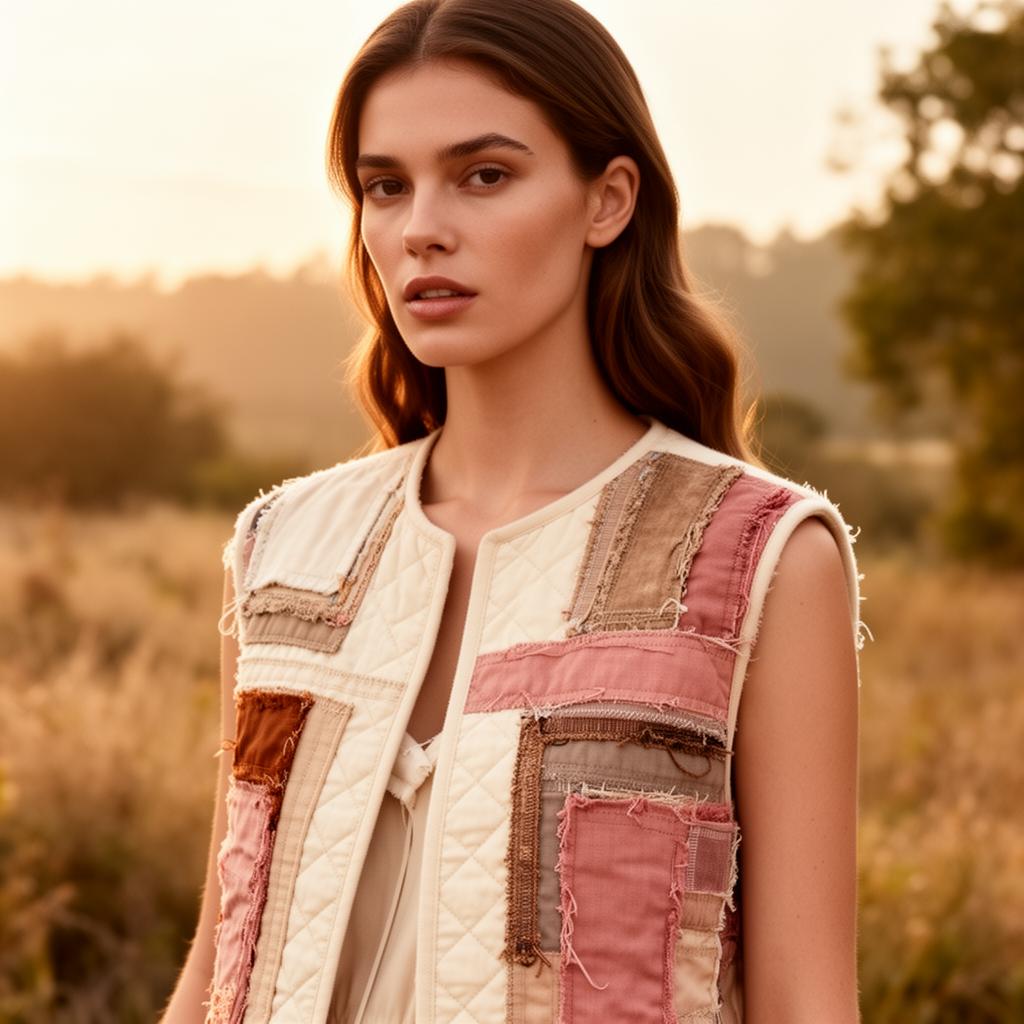
The Quilted Vest: Construction and Creative Potential
The Functional Origins of a Hybrid Garment
The sleeveless jacket, often called a vest or body warmer, has its roots in utilitarian wear. Originally designed as a thermal layer for sports, outdoor work, or equestrian activities, its primary function was to preserve body heat while ensuring complete freedom of movement for the arms. This functional simplicity explains its longevity and ability to transcend eras. Devoid of sleeves, its construction focuses on the torso, making it a unique textile object—somewhere between an accessory and a full-fledged garment.
Quilting: A Blend of Technique and Aesthetics
The recent popularity of the vest is largely due to the sophistication of its manufacturing techniques, chief among them being quilting. This method, which involves stitching together multiple layers of fabric, is no longer just an insulation solution. It has become a true aesthetic language.
Structure and Insulation
Quilting creates a three-dimensional structure. A layer of insulating material (wadding, down, recycled fibers) is sandwiched between two fabrics. The seams that run through these layers do more than just hold them together; they create patterns (diamonds, lines, waves) that sculpt the garment's surface and distribute the filling evenly. The choice of filling is strategic: lightness, thermal performance, compressibility, and increasingly, circularity, dictate the material selection.
A Medium for Expression
Beyond its function, quilting is a style marker. It gives the garment a volume and texture that catch the eye. Designers use it to play with shapes, create unexpected volumes, or simply add a strong visual signature. The density of the stitching, the design of the patterns, and the thickness of the filling are all parameters that can transform a simple piece into a complex design object.
Patchwork as an Assembly Method
Alongside the technical sophistication of quilting, another approach is gaining traction: patchwork. Historically associated with craftsmanship and the need to reuse scraps, this technique is now taking on a new dimension in the context of fashion's circular economy.
Modern patchwork is not just a random juxtaposition of fabrics. It is a conscious compositional work, where the harmony of colors, textures, and prints is carefully considered. For a piece like the sleeveless jacket, whose construction is fragmented into panels (front, back, sometimes sides), patchwork is particularly well-suited. It allows the garment to be conceived as a canvas, with each patch being a fragment of a material's story.
This approach makes it possible to valorize fabric swatches that are too small for conventional use, turning what could be waste into a creative resource.
The Sleeveless Jacket: An Experimental Ground for Upcycling
The vest's simple construction makes it an ideal candidate for upcycling. The transformation of existing textile materials (end-of-rolls, unsold garments, deadstock) into new, high-value-added pieces finds a prime medium in this garment.
- Material Savings: Its smaller surface area and lack of sleeves allow for working with smaller lengths of fabric, optimizing the use of upcycled fabric batches.
- Disassembly and Reassembly: The sleeveless jacket can be designed from panels taken from different garments, enabling creative combinations of materials and colors.
- Durability: By using high-quality existing textiles, upcycling creates durable pieces that are built to last, far from the logic of fast fashion.
The transformation of the material is at the heart of this challenge. The goal is not just to reuse, but to transcend the original function or aesthetic of the textile to create a new product whose perceived value is greater than that of its components. The sleeveless jacket thus becomes a showcase for the know-how related to the second life of materials, demonstrating that it is possible to combine design, circularity, and technical excellence.