
Decoding Textile Labels: A Guide to Conscious Consumption
In an increasingly complex textile industry, labels and certifications are essential benchmarks. They allow consumers to learn about the environmental and social impact of the products they buy and to identify companies committed to responsible production methods. To provide clarity, we offer an overview of the main standards in effect.
The Main Labels and Certifications to Know
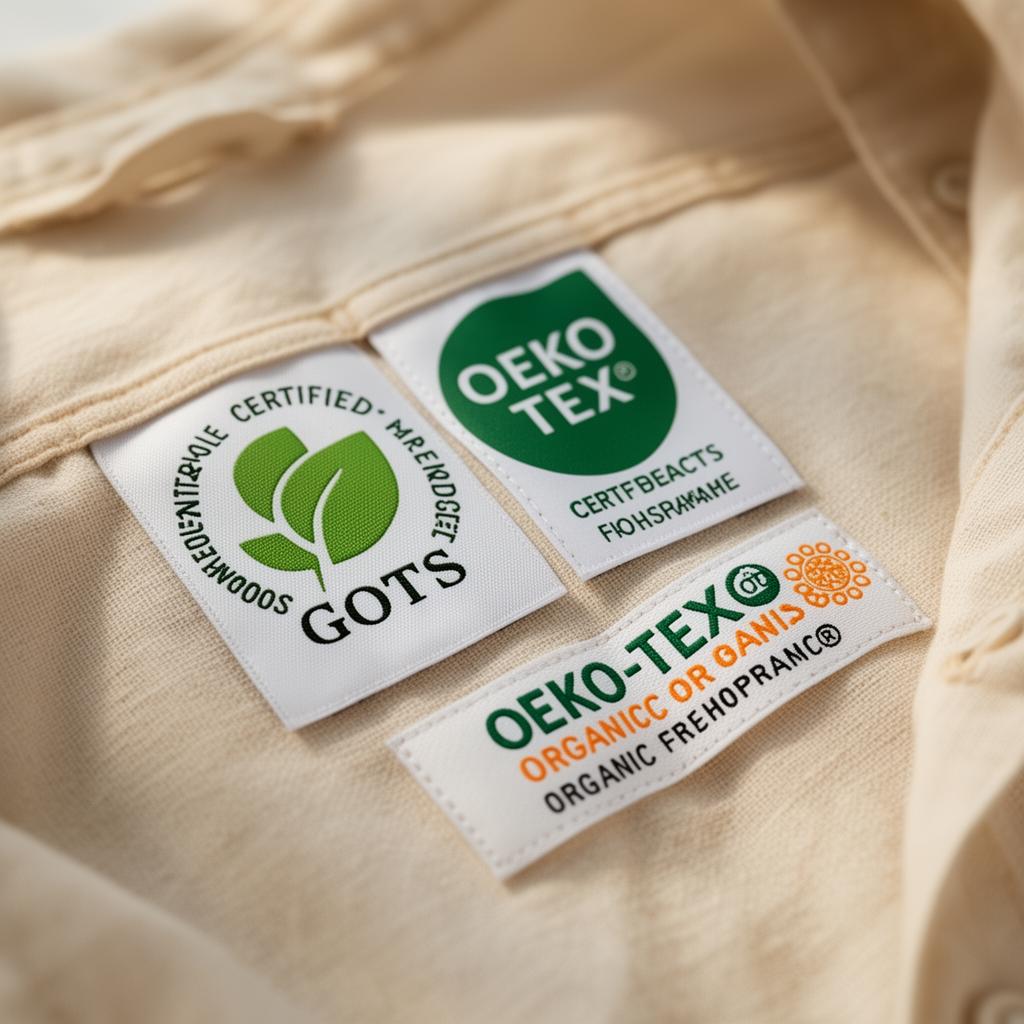
- GOTS (Global Organic Textile Standard): This benchmark certification guarantees not only the organic origin of textile fibers but also adherence to strict environmental and social criteria at every stage of the production chain.
- Oeko-Tex Standard 100: This label ensures that the final product has been tested and certified to be free of chemical substances considered harmful to human health. It focuses on the safety of the textile when in contact with the skin.
- Fairtrade: The Fairtrade label certifies that producers and workers, especially farmers, have benefited from decent working conditions and fair compensation for their labor.
- BCI (Better Cotton Initiative): This is a program that aims to promote more sustainable cotton farming. It encourages agricultural practices that reduce water and chemical use while improving the livelihoods of farmers.
- EU Ecolabel: This official ecolabel of the European Union certifies a reduced environmental impact throughout the product's entire life cycle, from raw material extraction to manufacturing, distribution, and end-of-life.
- Bluesign: This standard covers the entire textile production chain. It aims to eliminate potentially harmful substances from the very beginning of the manufacturing process, thereby ensuring production is safe for workers, consumers, and the environment.
- GRS (Global Recycled Standard): This label certifies the presence and percentage of recycled materials in a product. It also ensures the traceability of materials and compliance with social and environmental criteria in the recycling and manufacturing process.
How to Navigate the Complexity of Labels
Faced with the proliferation of certifications, it can seem difficult to find your way. Here are a few principles for assessing the relevance and credibility of a label.
- Analyze the scope of each label: Each standard has its own criteria. It is important to understand what it certifies precisely: some focus on organic composition (GOTS), others on chemical safety (Oeko-Tex), and still others on social aspects (Fairtrade).
- Verify the independence of the certifying body: The most credible labels are issued by third-party organizations that are independent of the brands they audit. Their impartiality is a guarantee of trust. Find out about the entity behind the logo.
- Refer to official sources: Organizations or public authorities publish guides and lists of recognized certifications. Consulting them helps you become familiar with reliable standards and avoid unfounded marketing claims.
- Assess the brand's overall approach: A label provides information, but it doesn't tell the whole story. A truly committed brand communicates transparently about its entire value chain, beyond just the certifications of its products.
The Certification Process: How Does It Work?
Obtaining a label or certification is not automatic. It is the result of a rigorous process conducted by independent bodies, which generally breaks down into several key stages.
- Application file: The company wishing to be certified submits a detailed file presenting its products, suppliers, manufacturing processes, and social and environmental policies.
- On-site audit and evaluation: An auditor from the certification body visits factories and production sites to verify that practices comply with the label's specifications. This phase may include inspections, document analysis, and interviews.
- Audit report and corrective actions: At the end of the evaluation, a report is drawn up. If non-conformities are detected, the company must implement corrective actions to comply.
- Issuance and monitoring: Once compliance is confirmed, the certification is issued for a given period. Follow-up audits are then carried out regularly to ensure that the required standards are maintained.
Labels as a Tool for Informed Consumption
Labels and certifications play an undeniable role in promoting more responsible fashion. By opting for products certified by standards like GOTS, EU Ecolabel, or GRS, consumers send a strong signal to the market and support players who invest in practices that respect the environment and human rights.
However, it is important to keep in mind that these certifications are not an end in themselves. They are valuable indicators of a company's commitment but should be considered as part of a broader assessment. A brand's transparency, its business model, its waste management policy, or its commitment to circularity are other elements to take into account.
By learning to decipher them, we empower ourselves to make more conscious choices. These tools, combined with our own curiosity and critical thinking, allow us to actively participate in the positive transformation of the textile industry.
The Azala team