
Managing Product End-of-Life
The circular economy is often cited as the most effective solution for making our industries more sustainable. Yet, the question of the business model is often set aside. To build a more perennial economy, every link in a manufactured product's life cycle must be addressed.
The first step of a circular economy is built upstream in the value chain (during manufacturing and before commercialization), which is also when a product's ecological and social impact is greatest. Yet, upstream in the value chain, the business model for brands is purely marketing-driven.
Why? Because there is no financial advantage to manufacturing more sustainably, aside from the "marketing" or "sales" argument that appeals to the end consumer's conscience. A few other levers can also come into play: legislation or the forward-thinking nature of brands and entrepreneurs.
Conversely, downstream in the value chain (from commercialization to a product's end-of-life), there are multiple circular economy-friendly business models. A growing number of companies are offering innovative concepts to extend the lifespan of their products and to help limit overproduction on a global scale. It is precisely this link in the value chain that we will focus on!
1 – Limiting Overproduction: The Virtuous Pre-Order Model
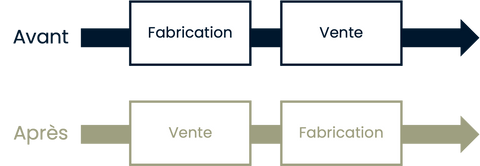
The traditional production cycle generally involves manufacturing before selling. This model has a clear advantage for the consumer: satisfying their need instantly, or in the short-term for online sales. The seller also benefits from their stock, notably through the corollary ability to offer immediate access to their product.
However, the negative externalities of this model are numerous. From an ecological standpoint, producing and then selling generally implies overproducing and then over-discounting. For companies, this model entails a loss of added value. This loss is compensated by the long-term sustainability of this business model. In other words, companies sell at a higher price during normal periods to be able to lower prices during sales periods. Discounted sales are not the core of the problem; they at least have the merit of attracting a less affluent clientele. But this model encourages companies to produce more and customers to consume more. Another, even more worrying, side of the problem concerns the immense volume of unsold goods being destroyed, mainly in the luxury industry...
Ultimately, building a "fair" price inevitably implies a system change. Pre-ordering appears to be an effective solution. Many companies, especially in the apparel sector, have championed this model, like REUNI, which invites its customers to co-create its collections. Introducing a dose of pre-ordering allows the retailer to avoid having to finance their stock and largely solves the problem of unsold items and their dramatic impact.
2 – Extending Product Lifespan: Opting for Second-Hand
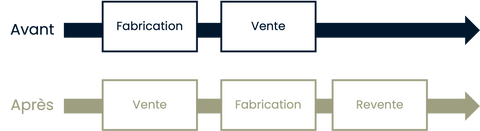
Once a product is sold, the merchant generally loses control over managing its end-of-life. Yet, this is a real problem!
On average, we wear our clothes fewer than 10 times (OXFAM), and this number seems entirely disconnected from the product's condition. This means that a significant number of perfectly usable products are sitting dormant in our closets, while 100 billion garments are still being produced each year (ADEME).
Second-hand is certainly trending, through numerous platforms that allow for the resale of used items. However, it would be much more efficient to return this link in a product's life to the brands themselves. Why? On one hand, because platforms encourage overconsumption, in a not-so-eco-friendly way, by pushing a certain clientele to wear clothes only once or twice before getting rid of them. And on the other hand, because brands lose control over managing their products' life cycle.
Several pioneering brands have launched their own second-hand marketplace, allowing customers to resell the brand's products they no longer need. This is the case for Jacadi, for example, which offers the possibility of buying new or second-hand items on its own platform. This mechanism is very effective for influencing the environmental impact of products, while having an obvious business model: that of a marketplace. The brand that created the product can attest to its authenticity, while also being the most capable of verifying its condition. But above all, it gives them the opportunity to build a model for their products' end-of-life...
3 – Product End-of-Life: What's the Business Model?

Once products have been sold, and then resold, there comes a time when the product is no longer in a usable condition. What are the solutions for brands?
Downcycling
Not always feasible, and often not very profitable, downcycling aims to transform products into raw materials so they can be used for different purposes. In the fashion industry, downcycling consists, for example, of shredding clothes to be used in making insulation materials for construction. Very often, the benefit for merchants is minimal and the utility is quite low since the quantity of recycled materials for insulation is in surplus.
Upcycling
Upcycling is the recycling process that allows for the creation of new products of the same use from end-of-life products. In the collective imagination, this process is often seen as unprofitable for large brands because the method is difficult to industrialize. However, this is not always the case.
We have seen the rise of the refurbished industry in electronics, yet in some industries, like textiles, the task seems insurmountable. It is, however, conceivable to rework end-of-life products industrially, just as one would with raw materials. The main difficulty lies in the lack of standardization of the end-of-life product, unlike a roll of fabric. A mixed transformation process (upcycling and downcycling) should help to partially overcome this difficulty. By sorting products by reference and by "level of degradation," and by saving a portion of the raw material purchase cost, one might wonder if remanufacturing isn't more profitable than destroying! In any case, from an ecological point of view, the calculation is simple.
Azala: What Model for a Young Start-up?
Clearly, for a new company, the issues of pre-ordering, managing second-hand items, or end-of-life are more complicated to tackle.
Building a Model Step by Step
For a new company, the immense advantage is being able to build its entire supply chain by adopting a new model. But when it comes to post-commercialization, it is necessary to anticipate the development stages downstream in the value chain.
Regarding Azala, the model we have chosen is the one presented in this article. Favoring pre-orders (mid-2023), keeping control of the product by offering the resale of second-hand items (end of 2023), and finding an economic model for the end-of-life of products (we are still thinking about it).
Sofiane Bouhali for Azala