
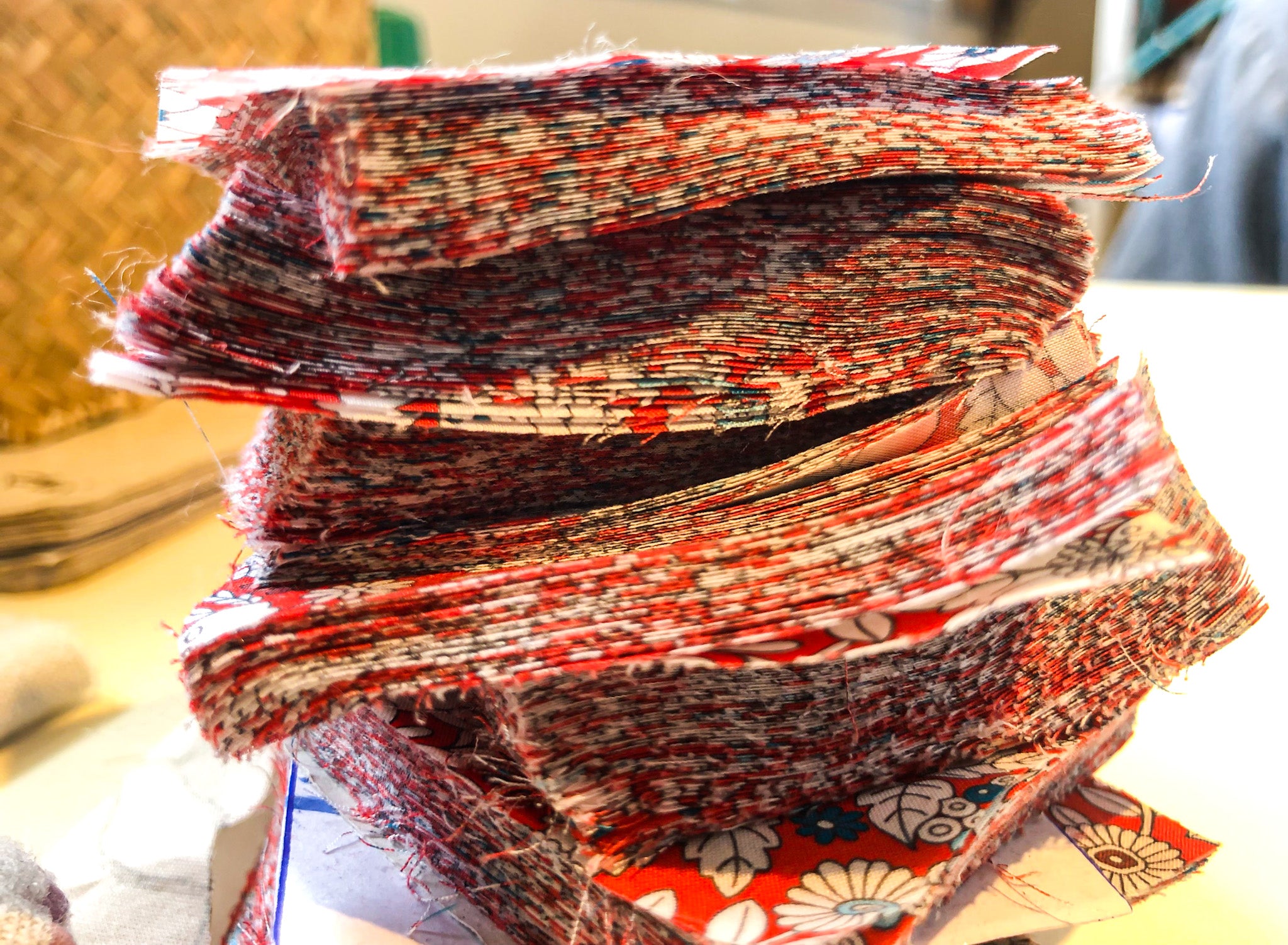
Recycling Without (Re)manufacturing: A 60 Billion m² Idea
Recycling is undoubtedly the most efficient way to reduce the environmental footprint of the textile industry. However, to have a significant impact, it's important to consider the various existing levers for action.
Recycling can refer to countless distinct processes. This is particularly true in the textile industry, where industrial waste is recycled and fabrics are upcycled or downcycled. Each of these concepts involves numerous manufacturing or (re)manufacturing techniques.
Every initiative aimed at reworking textile waste is valuable, yet some obvious areas for improvement are often overlooked. By examining the textile supply chain, we can identify the key stages where waste is generated. A 2015 MIT study, cited by Fashion Revolution, shows that approximately 15% of all manufactured fabric is lost as waste, primarily during the cutting process, accounting for nearly 60 billion square meters of discarded fabric each year.
Fabric Cutting: A Breeding Ground for Waste
In most cases, fabric manufacturers are not garment makers. Fabrics are delivered in rolls to garment factories (especially woven fabrics). Once these fabrics are received, the cutting process begins. The garment maker must optimize the placement of the pattern pieces on the fabric to maximize its use. Today, most placements are done digitally using specialized software.
It is estimated that the average fabric utilization rate after cutting is between 80% and 85%. This means that 15% to 20% of the fabric is unused and treated as production waste.
Fabric Cutting: How to Optimize?
Several solutions co-exist to address this dead loss.
Upcycled Yarn
"Upcycled" solutions, for example, aim to create new yarn from fabric scraps. Nevertheless, upcycled yarn has the disadvantage of being less robust and therefore always needs to be blended with new, high-quality fibers (on average, a mix of 30% recycled yarn to 70% "new" yarn is used).
Downcycled Solutions
Fabric scraps are often shredded and transformed into insulation materials, mattress stuffing, carpets, etc. Downcycling allows textile industry waste to be reused, but it has the disadvantage of underutilizing a noble resource to create low-value-added products.
The Azala Solution
While upcycling and downcycling solutions have many advantages, they are not always optimal. It is possible to develop an intermediate process aimed at maximizing the use of small fabric scraps by optimizing the cutting stage.
First, by focusing on pre-cutting placement, although software is becoming increasingly efficient and some promising solutions are reducing waste rates, the use of most fabrics remains suboptimal as things stand.
A simple (tested and approved) solution is to systematize the maximum use of fabrics: how can this be done?
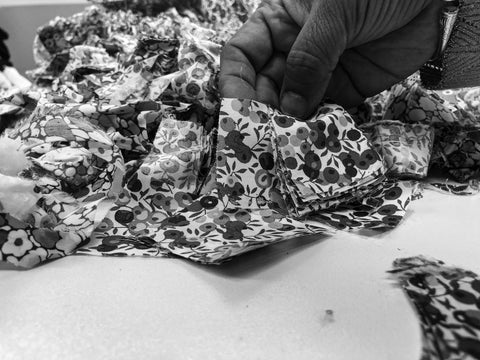
The parts of a garment are not interlocking geometric pieces (e.g., sleeves, collars, legs, etc.), which makes it impossible to use 100% of the fabric rolls. However, on the 15% to 20% of unexploited fabric, it is possible to place assemblable geometric shapes. For example, identical squares can be added in the unused fabric sections. Thus, instead of having irregular fabric scraps after cutting, we end up with a quantity X of fabric squares. This is a simple way to significantly reduce the waste rate (depending on the size of the squares).
Squares for what purpose?
When we recover our identical fabric squares, we have a raw material of the same quality, which we can then reuse – in the form of patchworks, for example. Thus, we create patchworked garments with the original fabric. Not to mention the undeniable aesthetic aspect, the logic is easy to understand. Admittedly, this process is more costly than simply using a whole cloth, since the squares have to be reassembled, but it is qualitatively identical.
Depending on the size of the squares and the initial cutting placement, we can reduce the waste rate from 15% to less than 5% (tested and approved). On a global scale, this represents a potential saving of nearly 40 billion square meters.
For the remaining 0%-5% of waste, there are vast uses in manufacturing. Without technological investment, it is possible, for example, to recreate padding from shredded micro-scraps.
Whether industrially or artisanally, solutions exist to recycle 60 billion square meters of discarded fabric.
The Azala solution is easily reproducible and requires no investment for garment manufacturers. This technique aims to offer a concrete solution to a huge friction point; 60 billion square meters of waste represents several billion garments thrown away before they have even been made.
A major difficulty in recycling is economic. There are many techniques and know-how that can drastically limit waste production, but few economic outlets for manufacturers. Just as a fabric manufacturer is not a garment maker, a garment maker is generally not a designer and distributor. For some efficient solutions to emerge, the impetus must come from brands and distributors, but also from consumers…
Source:
Original quote: “For example, it is estimated that 400 billion square metres of textiles are produced each year globally and 60 billion square metres (equalling 15% of all textiles produced) end up as cutting floor waste (MIT, 2015).”
Source: Fashion Revolution written evidence to the ‘Sustainability of the fashion industry’ inquiry, U.K. Environmental Audit Committee : Fashion Revolution. (n.d.).
Primary Source: MIT 2015
Sofiane Bouhali for Azala