
How to Reduce the Carbon Impact of Our Clothes?
Summary
- Key takeaway: the fashion industry emits as much CO2 as a G7 country.
- Energy abundance has kept the textile industry in a linear production model: production, use, then destruction. This model has enabled cost and price reductions, but remains environmentally inefficient.
- The clothing industry is a victim of an energy rebound effect: despite advantageous energy conditions and a growing market, and in spite of digitalization giving rise to the second-hand market, the utilization rate of our clothes is constantly decreasing.
- A glimmer of hope: industry players have developed new methods aimed at reducing the carbon footprint of clothing.
- Upcycling and reusing fabric scraps: an effective way to transform the industry and reduce its impact.
- Producing less without destroying value: the new impact business models of the fashion industry.
1 - The fashion industry emits as much CO2 as a G7 country
According to a Quantis (BCG) study, the textile industry as a whole (from production to distribution), represents 8% of global greenhouse gas emissions (2016), as much as a country like France (c. 4 million tons of CO2 equivalent). Furthermore, these emissions are equivalent to those of global air and maritime transport combined each year.
Contrary to common belief, it is neither transport nor distribution that weighs most heavily on the industry's carbon footprint. Indeed, a significant part of the environmental impact comes from the upstream production phase. Spinning and dyeing, or bleaching, alone account for 28% and 36% of the sector's total emissions, respectively, due to the high energy required for each of these stages. Moreover, India, China, or Bangladesh, which are among the largest producers, have an energy mix largely dependent on non-renewable energies (coal and natural gas).
2 - Energy abundance has kept the textile industry in a linear production model: production, use, then destruction. This model has lowered costs and prices, but remains environmentally inefficient.
The textile industry is built on a linear model of production and consumption: using non-renewable resources extracted for the manufacturing of clothes that are underutilized over time, then often thrown away or destroyed. Logically, this model encourages over-production and therefore over-consumption, due to low labor and raw material costs. The abundance of fossil fuels (oil, coal, gas) is directly correlated with these low costs. Furthermore, the upstream part of the value chain does not encourage the reuse of materials given the production prices.
The effect of this phenomenon is that only 1% of production materials are recycled to (re)make new clothes. A topic already explored at Azala, the quantity of fabric thrown away even before being used is immense, nearly 60 billion square meters of fabric are discarded each year in fabric production (i.e., between 15 and 20% of the volume of fabric produced). This immense loss also reveals possible improvements and optimizations, especially by changing the decision-making method beyond the price factor. Logically, this new economy will increasingly need profiles trained in these new skills and constraints. Responsible buyers or responsible supply chain managers will be at the heart of the transformation process, by modifying their supplier and material selection criteria to account for the negative externalities of industrial clothing production (energy cost, CO2 emissions, etc.).
3 - The clothing industry is a victim of an energy rebound effect: despite advantageous energy conditions and a growing market, and in spite of digitalization giving rise to the second-hand market, the utilization rate of our clothes is constantly decreasing.
The abundance of affordable primary energies in producing countries, coupled with the massification of production in these same countries, has led to a considerable drop in manufacturing costs and product prices. Although the share of household budgets devoted to clothing has constantly decreased since 1960 (from 9% in 1960 to 3% in 2015), the price drop has not been fully integrated (see graph below). Similarly, while the cost reduction is partly passed on to prices, overall purchase volumes have continued to increase. In other words, the price drop has resulted in an increase in the quantity of products purchased by consumers. This implies that products are worn less, and the industry's emissions have drastically increased.
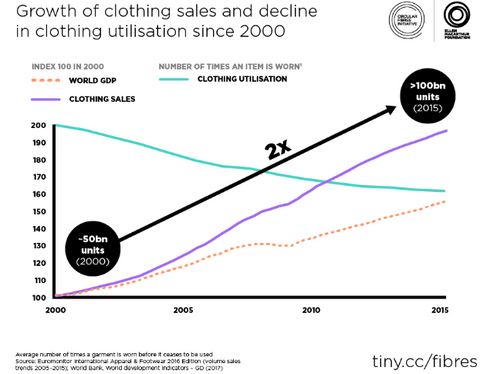
Furthermore, the arrival of digitalization with exchange platforms such as Ebay, Leboncoin, or more recently Vinted has absolutely not reversed the trend (increase in manufactured and sold volumes). Once again, the reduction in costs and accessibility (user experience) has contributed to the overall increase in consumption. According to BCG, 70% of platform users reportedly resell their second-hand products to increase their purchasing power on the new market, despite the CSR approach of these platforms.
4 - A glimmer of hope: industry players have developed new methods aimed at reducing the carbon footprint of clothing
The stark ecological reality has prompted manufacturers to innovate, partly under pressure from brands committed to their own transition. The least expensive measures in financial or technical terms were the first to emerge, because the price constraint imposed by clients does not seem to have changed. These persistently low prices make the industry's transformation difficult. However, some players have found innovative solutions, like Decathlon, in partnership with its Asian suppliers, which has developed a cold-dyeing technique, significantly reducing the process's energy needs.
To do this, Decathlon appointed a supply chain manager in charge of low-carbon purchasing and new manufacturing processes. A job of the future. Examples of innovation are numerous. A new dyeing process for the inner lining of a down jacket has made it possible to reduce carbon emissions by 40% and those of PM 2.5 fine particles by 66%.
5 - Upcycling and reusing fabric scraps: an effective way to transform the industry and reduce its impact
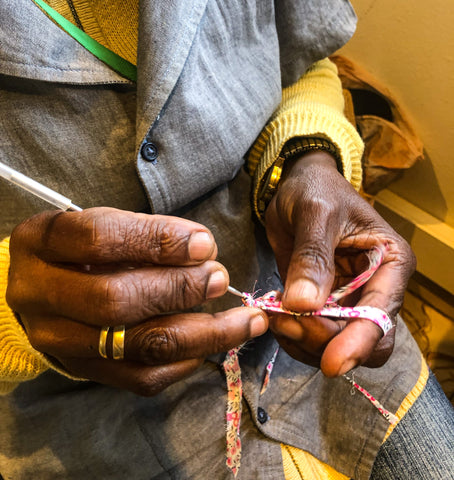
Innovations aimed at decarbonizing the textile industry are numerous and are segmented across all stages of the fashion industry's value chain (spinning, weaving, manufacturing, sales, recycling / upcycling). As mentioned earlier, recycling clothes is at the heart of ecological concerns because the manufacturing and transformation of raw materials represent, on average, nearly 80% of a garment's carbon emissions. Therefore, our ability to design new products from existing materials can have a significant impact on the industry's balance sheet. Upcycling is the name of the process describing the transformation of used clothing or fabric scraps into new garments. This process has the advantage of acting on all links in a garment's life cycle: it partially replaces the manufacturing of raw materials and allows for the re-importation of part of the manufacturing process to areas where electricity is less carbon-intensive. Furthermore, recycling fabric scraps or used clothing directly addresses the quantity of waste produced.
6 - Producing less without destroying value: the new impact business models of the fashion industry
While solutions exist to bring the textile industry more in line with the challenges of ecological transition, the fact remains that a reduction in overall consumption is inevitable. A substantial portion of our clothing is worn less than 10 times before being thrown away, donated, lost, or resold. This observation calls for reflection on ways to encourage extending the use-life of textile products. From the consumer's point of view, the answer seems simple and aims to direct purchasing acts towards higher quality consumption, while promoting the circularity of clothes through resale or donation.
From the perspective of manufacturers and brands, possibilities exist to build more virtuous business models (provided they do not lead to an increase in sales via the rebound effect of savings leading to more new purchases): pre-orders, clothing rental, resale of second-choice items, recycling / upcycling, etc. This non-exhaustive list of "new" business models supports a more circular and less carbon-intensive economy. Indeed, brands have every interest in thinking about viable models for the entire life of their products in order to continue creating value without producing more.
The fashion industry finds itself in the absolute necessity of transforming to meet climate challenges. While the industry's carbon footprint is very large, there are many viable solutions to reduce the resulting greenhouse gas emissions. In this sense, it is necessary to consider a garment by its overall footprint, beyond the price. From the buyers' perspective, the trend of more eco-friendly consumption is increasingly prevalent, and from the public authorities' point of view, it seems necessary to support this trend by taking imported pollution into account in product taxation, so as to reflect a fair price regarding ecological considerations.
Furthermore, beyond the industry's carbon footprint, the means aimed at producing fewer raw materials must allow for a significant limitation of biodiversity destruction directly linked to clothing manufacturing (micro-particles, water pollution, deforestation, etc.).
Joseph Hermet for KLIMA School and Sofiane Bouhali for Azala